BARA Trunk Swap

We are pleased to announce the 2026 Blossomland Amateur Radio Association Trunk Swap is a go!
Where: Five Pines Ministries, 6597 Smith Rd, Berrien Center, MI 49102
When: Saturday, September 19th; Set-up at 8:00AM and sales from 9:00AM to 1:00PM Rain or Shine!
Cost: None, though donations are greatly appreciated!
Sell from your trunk, truck, or bring a table! Canopies are welcome.
Talk in on the 146.820MHz W8MAI repeater (neg. offset, 88.5 PL)
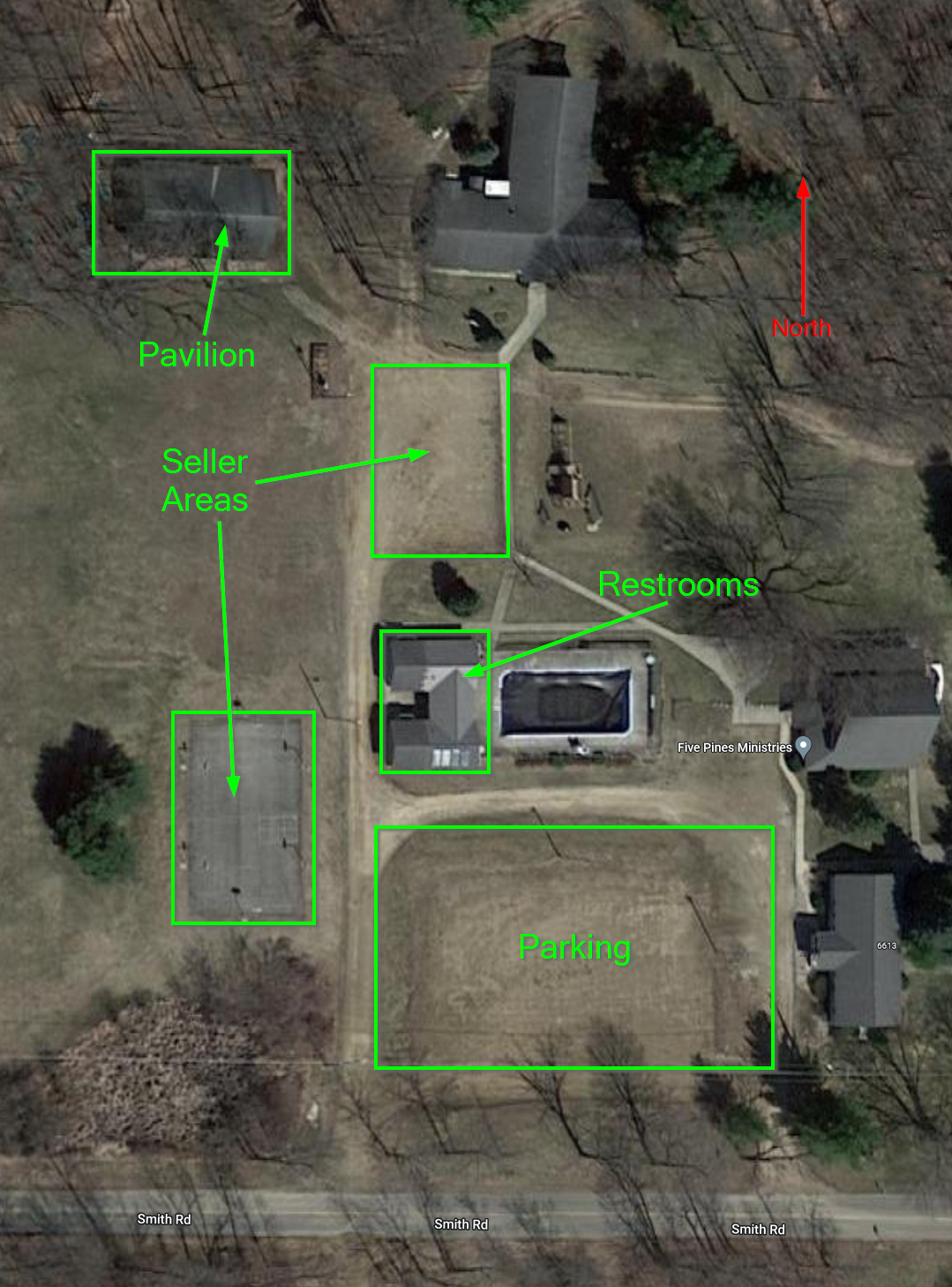
Please see below for a map of the Five Pines ground for the areas that we will be using. The South Vendor area (basketball court) is for vendors selling from a table and should not be used for parking. Vendor space is first come, first served.
UPDATE 3/5/26: This year's event will solely be hosted by the Blossomland Amateur Radio Association. Stay tuned to this page for any updates.
UPDATE 3/6/26: The date has been moved to Saturday, September 19th
ARRL News
12 March 2026
The American Radio Relay League (ARRL) is the national association for amateur radio, connecting hams around the U.S. with news, information and resources.
-
The ARRL Solar Update
Solar activity continued at low levels with isolated C-class
flaring. Regions 4381 and 4384 remained the primary drivers of
activity. The largest event of the period was a C2.9 flare from
Region 4381 on March 3. Region 4384 continues to rotate further onto
the disk, but foreshortening still hinders a definitive
characterization of its magnetic complexity. Region 4378 showed some
new flux emergence bu...
-
The ARRL Solar Update
Spaceweather.com for February 27 reports about a minor CME hurling
towards Earth.
Solar activity remains at low levels due primarily to C-class flares
just beyond the SE limb near S21. The largest was a C5.3 flare on
February 25. On the visible disk, an approximate 5-degree filament
eruption was observed centered near S08W27 with an associated C2.6
flare.
The eruption was accompanied by a Type II radi...
-
Hams Help Forecasters with Real-Time Data on Northeast Blizzard
A historic blizzard paralyzed much of the Northeast in late February, and amateur radio operators were on the air to help forecasters keep track of the storm’s impact. Southeastern New England was one of the hardest-hit areas. ARRL Eastern Massachusetts Section Emergency Coordinator and Boston-area SKYWARN Coordinator Rob Macedo, KD1CY, provided this summary for ARRL News:
A severe blizzard left...
-
Icom America Named Official Sponsor of the ARRL Year of the Club
-
ARRL Headquarters Closed on Monday, February 23, 2026
Due to a severe winter storm, ARRL Headquarters and the Maxim Memorial Station, W1AW, will be closed on Monday, February 23, for the safety of our staff. Connecticut Governor Ned Lamont has declared a state of emergency ahead of a blizzard that is moving into the state Sunday and continuing into Monday.
There will be no W1AW bulletin or CW practice transmissions on Monday.
Members can access many...
-
Job Posting: FCC Recruiting 7 Field Agents – Electronics Engineers
The Federal Communications Commission (FCC) is looking for qualified applicants for Field Agents in seven Enforcement Bureau (EB) offices across the United States: Atlanta, GA; Boston, MA; Chicago, IL; Dallas, TX; New Orleans, LA; New York, NY, and Portland, OR. Incumbents will resolve Radio Frequency (RF) interference, educate users, and enforce regulations. The GS levels for this position hav...
-
The ARRL Solar Update
Solar activity returned to low levels this past week. The strongest
event of the period was a C1.8 flare on February 17 from region
4374. This region was also responsible for a C1.4 flare on February
18. The only other flare of note was a C1.1 flare on February 17
from an unnumbered plage region near S05E85. (A plage region is a
bright, intensely hot region in the Sun's chromosphere, typically
found...
-
New Book Release: Digital Networking for Ham Radio
ARRL The National Association for Amateur Radio®’s new book, Digital Networking for Ham Radio, a practical, hands-on guide to designing and implementing high-speed data networks for amateur radio stations, is now shipping.
Written by Glen Popiel, KW5GP, the book brings together in one comprehensive resource the knowledge needed to build, configure, and expand digital networks for ham radio. From...
-
FCC Requires That FRN Contact Information Be Updated Within Ten Days of a Change
-
2025 ARRL Sweepstakes Icom Dream Station Winner Announced at Orlando HamCation®
ARRL The National Association for Amateur Radio® announced the winner of the 2025 ARRL Sweepstakes Icom® Dream Station on Saturday, February 14, at 2026 Orlando HamCation. The announcement was made by ARRL President Rick Roderick, K5UR, with Icom America Senior Sales Manager Ray Novak, N9JA.
The ARRL Sweepstakes ran from January 3 to December 31, 2025, as the centerpiece of a year-long membershi...
-
The ARRL Solar Update
Solar activity reached moderate levels early this week. The
strongest event was an M1.4 flare observed on February 11 in Region
4366. This region also produced nine C-class flares.
Region 4373 produced a C1.8/Sf flare on February 11. This region
displayed some minor area growth. Regions 4369 and 4371 exhibited
some minor decay. The other spotted regions remained unchanged. New
Region 4375 was number...
-
Radio Clubs Encouraged to Plan Now for April Ham Radio Open House
ARRL The National Association for Amateur Radio® is inviting radio clubs to participate in the second annual Ham Radio Open House in April. Hosting an Open House gives clubs and schools the opportunity to promote amateur radio science and technology by opening their stations to the public and showcasing their hi-tech gear and operating skills.
In addition, clubs are encouraged to set up in publi...
-
ARRL Mourns the Loss of Sharon Taratula, Awards Manager
ARRL The National Association for Amateur Radio® is saddened to share the news that Sharon Taratula, who served the League with dedication and distinction for 32 years, passed away on February 4, 2026.
Sharon joined ARRL on January 31, 1994, as DXCC Awards Technician. She later served as Administrative Assistant (1996), MVP Administrative Manager (2011), and from 2016 until her passing, as Award...
-
The ARRL Solar Update
Solar activity was at high levels for most of the week, dominated by
Region 4366. The most notable event was an impulsive X4.2 flare from
that region on February 4. Throughout the period, Region 4366
continued to exhibit a slight reduction in area and a modest
simplification of its magnetic complexity. The remaining numbered
regions on the visible disk remained stable or in a state of slight
decay.
T...
-
NCVEC Question Pool Committee Removes Three Questions from Use
12 March 2026
The American Radio Relay League (ARRL) is the national association for amateur radio, connecting hams around the U.S. with news, information and resources.-
The ARRL Solar Update
Solar activity continued at low levels with isolated C-class
flaring. Regions 4381 and 4384 remained the primary drivers of
activity. The largest event of the period was a C2.9 flare from
Region 4381 on March 3. Region 4384 continues to rotate further onto
the disk, but foreshortening still hinders a definitive
characterization of its magnetic complexity. Region 4378 showed some
new flux emergence bu... -
The ARRL Solar Update
Spaceweather.com for February 27 reports about a minor CME hurling
towards Earth.
Solar activity remains at low levels due primarily to C-class flares
just beyond the SE limb near S21. The largest was a C5.3 flare on
February 25. On the visible disk, an approximate 5-degree filament
eruption was observed centered near S08W27 with an associated C2.6
flare.
The eruption was accompanied by a Type II radi... -
Hams Help Forecasters with Real-Time Data on Northeast Blizzard
A historic blizzard paralyzed much of the Northeast in late February, and amateur radio operators were on the air to help forecasters keep track of the storm’s impact. Southeastern New England was one of the hardest-hit areas. ARRL Eastern Massachusetts Section Emergency Coordinator and Boston-area SKYWARN Coordinator Rob Macedo, KD1CY, provided this summary for ARRL News:
A severe blizzard left...
- Icom America Named Official Sponsor of the ARRL Year of the Club
-
ARRL Headquarters Closed on Monday, February 23, 2026
Due to a severe winter storm, ARRL Headquarters and the Maxim Memorial Station, W1AW, will be closed on Monday, February 23, for the safety of our staff. Connecticut Governor Ned Lamont has declared a state of emergency ahead of a blizzard that is moving into the state Sunday and continuing into Monday.
There will be no W1AW bulletin or CW practice transmissions on Monday.
Members can access many...
-
Job Posting: FCC Recruiting 7 Field Agents – Electronics Engineers
The Federal Communications Commission (FCC) is looking for qualified applicants for Field Agents in seven Enforcement Bureau (EB) offices across the United States: Atlanta, GA; Boston, MA; Chicago, IL; Dallas, TX; New Orleans, LA; New York, NY, and Portland, OR. Incumbents will resolve Radio Frequency (RF) interference, educate users, and enforce regulations. The GS levels for this position hav...
-
The ARRL Solar Update
Solar activity returned to low levels this past week. The strongest
event of the period was a C1.8 flare on February 17 from region
4374. This region was also responsible for a C1.4 flare on February
18. The only other flare of note was a C1.1 flare on February 17
from an unnumbered plage region near S05E85. (A plage region is a
bright, intensely hot region in the Sun's chromosphere, typically
found... -
New Book Release: Digital Networking for Ham Radio
ARRL The National Association for Amateur Radio®’s new book, Digital Networking for Ham Radio, a practical, hands-on guide to designing and implementing high-speed data networks for amateur radio stations, is now shipping.
Written by Glen Popiel, KW5GP, the book brings together in one comprehensive resource the knowledge needed to build, configure, and expand digital networks for ham radio. From...
- FCC Requires That FRN Contact Information Be Updated Within Ten Days of a Change
-
2025 ARRL Sweepstakes Icom Dream Station Winner Announced at Orlando HamCation®
ARRL The National Association for Amateur Radio® announced the winner of the 2025 ARRL Sweepstakes Icom® Dream Station on Saturday, February 14, at 2026 Orlando HamCation. The announcement was made by ARRL President Rick Roderick, K5UR, with Icom America Senior Sales Manager Ray Novak, N9JA.
The ARRL Sweepstakes ran from January 3 to December 31, 2025, as the centerpiece of a year-long membershi...
-
The ARRL Solar Update
Solar activity reached moderate levels early this week. The
strongest event was an M1.4 flare observed on February 11 in Region
4366. This region also produced nine C-class flares.
Region 4373 produced a C1.8/Sf flare on February 11. This region
displayed some minor area growth. Regions 4369 and 4371 exhibited
some minor decay. The other spotted regions remained unchanged. New
Region 4375 was number... -
Radio Clubs Encouraged to Plan Now for April Ham Radio Open House
ARRL The National Association for Amateur Radio® is inviting radio clubs to participate in the second annual Ham Radio Open House in April. Hosting an Open House gives clubs and schools the opportunity to promote amateur radio science and technology by opening their stations to the public and showcasing their hi-tech gear and operating skills.
In addition, clubs are encouraged to set up in publi...
-
ARRL Mourns the Loss of Sharon Taratula, Awards Manager
ARRL The National Association for Amateur Radio® is saddened to share the news that Sharon Taratula, who served the League with dedication and distinction for 32 years, passed away on February 4, 2026.
Sharon joined ARRL on January 31, 1994, as DXCC Awards Technician. She later served as Administrative Assistant (1996), MVP Administrative Manager (2011), and from 2016 until her passing, as Award...
-
The ARRL Solar Update
Solar activity was at high levels for most of the week, dominated by
Region 4366. The most notable event was an impulsive X4.2 flare from
that region on February 4. Throughout the period, Region 4366
continued to exhibit a slight reduction in area and a modest
simplification of its magnetic complexity. The remaining numbered
regions on the visible disk remained stable or in a state of slight
decay.
T... - NCVEC Question Pool Committee Removes Three Questions from Use
Southgate Amateur Radio News
Amateur Radio Daily
12 March 2026
An aggregate of Ham Radio related news.-
2026 Hamvention Award Winners Announced
The following is a press release from the Hamvention Awards Committee:
The 2026 Awards team is pleased to announce the Hamvention Award Winners. It is always difficult to make our final decisions as we receive many excellent nominations. Please join us in congratulating these very deserving winners.
Michael Kalter
W8CI Award Chairman 2026Technical Achievement Award Robert Famiglio K3RF
Robert B. “Bob” Famiglio, K3RF, has spent almost 60 years in amateur radio, blending technical expertise, legal knowledge, and leadership in emergency communications. Licensed at 13, Bob earned a BSE in electrical engineering and a doctorate in law, now admitted to practice in several states and before federal courts and agencies while working in the technology sector. For more than 40 years he has served as Volunteer Counsel, advising hams on PRB 1 matters, zoning, and antenna ordinances, RFI enforcement, and club governance; his technical understanding of station engineering and interference resolution has informed effective legal strategies and regulatory comments.
Elected to ARRL leadership for multiple terms (EPA Section Manager, Atlantic Division Vice Director, and later Director), he championed member rights, transparency, and representative governance. Previously, Bob served several terms as Vice President & General Counsel of the Radio Club of America and functioned as corporate counsel for the board.
In emergency communications he served as ARES District Emergency Coordinator for Greater Philadelphia, supporting regional response agencies applying technical expertise, message handling, and interoperability between amateur and public safety systems; his formal training as a professional firefighter enhances his ability to align ham radio technology with operational needs of served agencies.
A long-time mentor, Bob supports on-air training nets and club programs stressing technical competence, regulatory literacy, and readiness for public service. He believes that amateur radio’s core value lies in the skills, service, and technical capability of operators, not merely spectrum access, and he has worked to translate complex technical issues—spectrum coexistence, interference mitigation, and regulatory compliance—into clear, actionable recommendations for policymakers. Bob’s blend of engineering, legal acumen, and emergency response experience has encouraged continuous training, lowered barriers to participation, and inspired new generations of ham radio operators.
Amateur of the Year Award Dr. Jose “Otis” Vicens NP4G
First licensed at the age of sixteen, Otis, known to friends and fellow operators on the air as NP4G, developed a passion for amateur radio. Born and raised in Humacao, Puerto Rico, he is the only amateur radio operator in his family.
Otis later moved to the United States to study Biology at Purdue University, where he became active with the W9YB Amateur Radio Club. One of his early memories of service through amateur radio was in 1998, when he helped provide communications support in Puerto Rico following Hurricane Georges. In Puerto Rico he graduated from the University of Puerto Rico School of Dental Medicine. He then completed a specialty program in Pediatric Dentistry at Brookdale University Hospital and Medical Center in Brooklyn, New York. In 2008, Otis returned to his hometown of Humacao to begin practicing orthodontics.
Early in his ham career Otis attended the DX Forum at Dayton Hamvention, where presentations on major DXpeditions inspired him to someday be a part of future adventures. He has now participated in many DXpeditions from all over the world including the very rare Bouvet Island (3Y).
Otis is very active in Puerto Rico ham radio. He is Past President of the Puerto Rico Amateur Radio League (PRARL) in 2012 and during the 2017 Puerto Rico hurricane disasters NP4G helped coordinate amateur radio emergency communications across eastern Puerto Rico following Hurricane Georges.
NP4G is now President of the International DX Association (INDEXA) and most recently was part of the all KP4 team to activate the very rare Desecheo Island with amazing technology as KP5/NP3VI.
Special Achievement Award Martha Fell N3QBE and Joe Fell W3GMS
Martha and Joe Fell’s journey began in 1966 when Joe earned his Novice license (WN3GMS) at the age of fourteen. Shortly thereafter, he met Harry I. Davis, W3FDY (SK), who mentored him for four years. Harry taught him to think critically, design circuits, and execute projects with precision. His guidance was life-changing, and Joe pledged to honor his request to give back to others just as Harry had done for him.
To fulfill this promise, Joe chose to retire at age 56, following a 34-year corporate career and the successful launch of his own company. The success of this mission is thanks to his wife, Martha, whose dedication to overseeing administration and logistics has greatly benefited their students.
Their program’s reach has grown significantly over the decades. In 1976, Joe designed and built a repeater for his mentor’s radio site which remains operational 50 years later, serving a group of approximately eighty-five operators. Their weekly technical net has become a primary resource for both new and seasoned amateurs, including many professional electrical engineers.
Today, they mentor students of all ages and interests. While their first student is currently pursuing a PhD in Electrical Engineering at MIT, their youngest started at just eight years old.
Club of the Year Long Island CW Club
Long Island CW Club (LICW) is an online Morse code training community built to help everyday hams become confident and proficient CW operators. We combine high standards with a welcoming culture: we teach real operating skills, we treat people with respect, and we keep learning for fun. LICW offers structured classes from beginner through advanced, a wide range of topical forums, and practice resources that help students move from “copying characters” to true conversational flow. Our instructors are volunteers who remember what it felt like to be new, and who coach students through plateaus with clear, effective teaching methods, encouragement, and accountability. LICW is also proud to be a diverse community, with strong participation and leadership across generations - including more than four hundred women who serve as instructors and club leaders - along with programs that support youth and hams with disabilities. LICW is a community - people who show up for each other, celebrate progress, and share the joy of CW on the air.
Source: Hamvention
-
K9 Veterans Day Activation Honors Military Dogs
The following is a message from the Dog Day Amateur Radio Club:
The Dog Day Radio Amateur Radio Club, K0DOG, best known for participation in International Dog Day each August, will be calling CQ in tribute to dogs who have supported members of the military over the years.
Starting at 0000 UTC March 12 through to 2359 UTC March 13, hams will be active on the HF bands using CW and SSB, commemorating K9 Veterans Day.
The late Joe White, a Vietnam veteran and K9 handler, popularized March 13th as K9 Veterans Day because the date marks the start of dogs’ formal military training in the US in 1942 through the formation of the K9 Corps, or the War Dogs Program of the US Army.
This amateur radio activation is a tribute to all dogs throughout history who have served – wherever they have served.
Learn more about hero dogs and how to be a part of this special celebration by visiting the QRZ.com bio page for K0DOG.
Source: Dog Day Radio Amateur Radio Club
-
RaDAR Rally 2026 Registration is Now Open
Registration is now open for the 2026 RaDAR Rally event. RaDAR is Rapid Deployment Amateur Radio, an event in which ham radio operators deploy into the field, make five contacts, then redeploy again all within a 4 hour window.
See the RaDAR Rally info page for registration details. The event takes place April 4th with registrations accepted through April 3rd. An intro video and roster are also available.
Source: RaDAR Rally
-
Students on the Air Satellite Activity Day StOTA
AMSAT recently announced Students On The Air (StOTA) Days in which students are invited to get on the air and work satellites the first and third Tuesday of each month.
The activity was inspired by AMSAT President Drew Glasbrenner, KO4MA, and his son Carsten, KQ4SJM, and is designed to promote regular on-air activity among licensed student operators.
All operators are encouraged to participate. More information is available on the AMSAT Discord server.
Source: AMSAT UK
-
Amateur Radio Newsletter Round-up for March 2026
The March issue of SWR Magazine:
- HamCation
- J-Pole for 6 and 10 meters
- Female Frequency
The SARC Communicator March-April 2026:
- Hidden features in the Icom IC-7300 transceiver
- Add Digital Television to Your ARES Tool Kit
- When an app outlives its creator
- Bluetooth hands free ops
- Reducing mains borne interference
- FreeDV
- Impressions of ARRL's New Digital Networking for Ham Radio Book
- New Amateur Radio Organization - Alliance Amateur Radio Society
- 2026 Hamcation AMSAT Forum | Drew Glasbrenner, KO4MA President's Update
- Seasonal propagation and an online propagation chart that updates every 15 minutes
- An exciting new BTECH DA-7X2 DMR/Analog Dual-Receive HT with a secret
- Looking inside a SHARI Node
Source: Amateur Radio Daily
-
Inovato, N0LSR Design Endorse Open HamClock Backend Public Server
Editor's Note: Amateur Radio Daily is a contributor to the Open HamClock Backend project and recommends their public server. Amateur Radio Daily headlines have appeared on HamClock since 2023.
Open HamClock Backend (OHB) is now providing a central server for any HamClock user to use with their existing HamClock application. With the original HamClock application scheduled to be sunset in June, the central server provided by OHB will extend the life of existing HamClock installations indefinitely. Previously, OHB users were required to host the server locally. This update allows any HamClock user to utilize OHB's central server through a small configuration change.
When the creator of HamClock became a silent key earlier this year, the HamClock project was expected to be sunset in June 2026. While the HamClock application is open source, the backend server that powers many HamClock features was closed. OHB provides a replacement for that backend service.
Open HamClock Backend (OHB) is a community project by a team of developers with Brian Wilkins (KO4AQF) as the main contributor. It is fully open source, and it runs on servers in a commercial data center. Another example of what the ham radio community is capable of. The hosting in the data center is donated. This provides very high availability with no costs for anyone.
With the stability of the OHB project making its way to a centralized public server, Inovato and N9LSR Design recently announced that they would endorse OHB for their HamClock appliances.
Source: N0LSR Design
-
futureGEO Continues to be a Topic of Discussion
It's been several months since we've heard movement regarding the futureGEO project, but events scheduled in 2026 appear to be keeping the geostationary satellite project top of mind among the amateur radio community.
A presentation by AMSAT President Drew Glasbrenner (KO4MA) at HamCation 2026 spoke to the value a project like futureGEO could bring to the Americas along with his desire to see such a project succeed. Glasbrenner touched on the financial requirements of a GEO satellite project while at the same time recognized organizations such as ARDC that have publicly expressed a desire to help fund a GEO satellite project. The roughly 6 minute segment can be viewed on YouTube.
At AMSAT-DL's Bochum Space Day in March, Frank Zeppenfeldt (PD0AP) of the European Space Agency (ESA) is scheduled to give a presentation focused on futureGEO. Details are unknown, but it could mirror similar lectures given by Zeppenfeldt in the past.
The same AMSAT-DL post about Bochum Space Day happened to communicate a futureGEO community workshop to be scheduled as part of HAM RADIO 2026. This workshop will be tapping into GEO satellite QO-100 users to help provide direction for futureGEO.
A futureGEO community workshop will take place at HAM RADIO 2026 in Friedrichshafen, to which all QO-100 users are cordially invited. This event offers ideal preparation for the QO100 user meeting on the same evening. At the same time, we want to use the expertise of all participants to successfully further develop the futureGEO project on behalf of ESA.
Source: Amateur Radio Daily
-
Bochum Space Day to Feature Live Contact with Antarctica
AMSAT-DL is hosting Bochum Space Day to coincide with Germany's Space Day and Day of Astronomy. The event will feature a series of events including lectures, futureGEO, and a live school contact with Neumayer Station III in Antarctica (DP0GVN).
At the same time, an ESERO family day will take place on this day from 11 am to 5 pm in and around the radome of Bochum Observatory under the motto “Adventure Space”: Fun & interesting facts for young and old await visitors; they can embark on a journey of discovery and immerse themselves in the world of astronomy and space travel.
Visit the AMSAT-DL website for a full schedule and overview.
Source: AMSAT-DL
-
RAC Names Recipients of Amateur of the Year Award 2025
Radio Amateurs of Canada (RAC) announced the recipients of the Amateur of the Year Award for 2025. This year's honorees, Fred (VE1FA) and Helen (VA1YL) Archibald, are recognized for their years of dedication to the amateur radio community.
Fred and Helen Archibald have been pillars of Amateur Radio in Canada for decades. While the award traditionally reflects contributions within a given year, their sustained excellence in 2025 – combined with a lifetime of service – made them compelling joint recipients.
In addition to being avid organizers of many DXpeditions, VE1FA is an instructor and technological innovator and VA1YL has served as President of the Canadian Ladies Amateur Radio Association. Learn more about Fred and Helen's contributions to ham radio on the RAC website.
Source: Radio Amateurs of Canada
-
Community HamClock Backend Server Now Available
Editor's Note: Since the publication of this article, Amateur Radio Daily has become a contributor to the Open HamClock Backend project and recommends their public server. Amateur Radio Daily headlines have appeared on HamClock since 2023.
In addition, hamclock.com has established a trustee agreement with PSKReporter.info maintainer Philip Gladstone.
The first known community backend server for HamClock is now available for all HamClock users. The project, hamclock.com, is free for anyone to use and will keep existing HamClock installs running indefinitely.
Major work beyond OHB includes: rewriting the VOACAP propagation engine with cubic interpolation, building weather pressure maps in both millibar and inHg units at five resolutions, adding aurora map generation, real-time PSK Reporter spot data, Kp index from NOAA SWPC, overhauling satellite TLE tracking, and hardening the entire server for production use serving 1,600+ HamClocks.
With the passing of HamClock creator Elwood Downey (WB0OEW), HamClock will stop working in June unless users point their installations to a new backend service. Updating existing HamClock installations is a simple task. Users have two options, updating their hosts file, or updating the command used to start HamClock. Both require only simple text changes.
Hamclock.com is run by Bruce Edrich (W4BAE) and is built upon open-hamclock-backend.
Source: HamClock.com
-
Southeastern VHF Society 2026 Conference Registration is Open
Registration is now open for the Southeastern VHF Society 2026 conference. The event will take place in Macon, Georgia, US April 17-19. The conference is focused on amateur radio operation on VHF frequencies and above.
The technical conference begins Friday morning and will include a Luncheon with a guest speaker and continue Technical Presentations in the afternoon, with dinner out on the town, and continue with an evening flea market and hospitality suite. Saturday morning the technical presentations continue and conclude early afternoon when the antenna range and Rover display opens.
Interested amateurs can register here.
Source: Southeastern VHF Society
-
Titanic Memorial Special Event Honors Telegraph Operators
The Titanic Memorial special event, EG1912T, takes place April 10th through April 15th honoring all on board the ship.
We particularly wish to honour those who participated in the rescue, especially the radio station managers and telegraph operators Jack Phillips, Harold Bride and Harold Cottam, who played a leading role in the telegraphic communications of the most shocking rescue in history: the sinking of the RMS Titanic.
The event will take place on all bands utilizing all modes with an emphasis on CW. QSL cards will be available via bureau. More information is available on the EG1912T QRZ page.
Source: EG1912T
-
DXLook.com Launches New Composite Views to Compare Real-World Contacts with Propagation Predictions
February 20, 2026 — DXLook.com has released two new composite map views designed to help amateur radio operators compare actual on-air results with propagation expectations in one place. The update adds Reports + MUF and Reports + VOACAP, allowing operators to see where signals are being reported versus where models suggest they should propagate—without switching between separate tools or screens.
New Composite Views
Reports + MUF
This view overlays real contact reports (solid arcs) on top of MUF (Maximum Usable Frequency) zones. The colored zones represent the highest usable band by direction, helping operators quickly confirm whether contacts align with expected openings and identify unusual paths such as grey-line effects, sporadic-E, or long-path propagation.Reports + VOACAP
This view overlays real contact reports (solid lines) with VOACAP theoretical predictions (dashed, semi-transparent arcs). It provides a direct side-by-side visual comparison between model-based expectations and real-world activity, making it easier to spot agreement, gaps, and surprises.How to Access
Operators can try the new views by visiting dxlook.com, selecting Reports + MUF or Reports + VOACAP from the View dropdown, then entering a callsign or grid square and clicking Go.Update Details
- The MUF/VOACAP prediction backdrop refreshes every 5 minutes independently
- Reports refresh based on the selected time window (1 minute to 24 hours)
- Existing Reports features remain available, including filters for band/mode/direction, marker options, and the spot table
DXLook.com is free to use, requires no login, and aggregates data from PSK Reporter, Reverse Beacon Network (RBN), WSPRnet, and DX Cluster, supporting bands from 160m through 2m.
About DXLook.com
DXLook.com is a web-based platform that combines reception reports and propagation-focused views to help amateur radio operators monitor activity, understand band conditions, and explore propagation patterns in real time.Source: DXLook
-
Zero Retries Digital Conference 2026 Announced
Zero Retries Digital Conference (ZRDC) will return for a second year on Friday, October 16, 2026. This year's conference will take place in Sam Ramon, California, USA at the Roundhouse Conference Center. Pacificon 2026 will take place the same weekend in the same city, just down the street from ZRDC.
An informal visit to the Computer History Museum will take place the Thursday before ZRDC 2026. (Editor's note: A visit to CHM is worth arriving early!)
Keep an eye on the ZRDC 2026 website for more details.
Source: Zero Retries Digital Conference
-
Honolulu Department of Emergency Management is Recruiting: Volunteer Amateur Radio Operators
The following is a message from Honolulu Department of Emergency Management:
When emergencies disrupt normal communications, RACES (Radio Amateur Civil Emergency Services) provides trained, licensed ham radio volunteers to keep information moving between the Emergency Operations Center (EOC) and field sites.
What you’ll do:
- Pass emergency traffic between the EOC and field sites (we will teach you Winlink and other modes).
- Share reports to support situational awareness.
- Train and participate in exercises to test backup communications.
Minimum qualifications:
- Amateur radio operator license (required).
- Permanent U.S. resident, 18+.
- Able to pass a federal fingerprint background check.
Apply here:
https://veoci.com/v/p/191705/workflow/7pgrj5u5q833If you’re a licensed amateur radio operator on Oʻahu and want your skills to matter when it counts, this is a direct way to serve your community.
Please feel free to share with anyone who may be interested. I welcome any questions or feedback.
Michael C. Miller, KH6ML
Deputy Coordinator
Radio Amateur Civil Emergency Services (RACES)
Department of Emergency Management - City and County of HonoluluAssistant Section Manager, Pacific Section
ARRL – The National Association for Amateur Radio® -
Amateur Radio Active at the Honolulu EOC During Severe Weather Activation
The following is a message from the Honolulu Department of Emergency Management:
February 8–9, 2026 | Honolulu, Hawaiʻi
On February 8–9, 2026, severe weather brought high winds, heavy rainfall, flash flooding, power outages, and hazardous surf conditions across Honolulu and the State of Hawaiʻi. Both Governor Josh Green and Honolulu Mayor Rick Blangiardi issued emergency proclamations to mobilize resources and protect public safety.
Amateur radio operators were activated inside the Emergency Operations Center (EOC) in support of the Department of Emergency Management (DEM), City and County of Honolulu. Volunteer communicators reported in and stood ready to provide backup communications should cellular or internet systems fail.
During the activation, we:
- Participated in county and statewide briefings with Governor Josh Green and Maj. Gen. Stephen Logan and Hawaii Emergency Management Agency (HI-EMA) leadership.
- Joined statewide HF nets at 9:00 a.m., 12:00 p.m., and 4:00 p.m. on 7.090 MHz (LSB).
- Updated and posted the ICS-205 Communications Plan on HawaiiARES.net for download and offline reference.
- Logged activity in the ICS-214 Unit Log.
- Operated at KH6OCD on HF and VHF/UHF voice, monitored repeaters, and utilized Winlink radio email on HF and VHF FM.
Radio traffic remained light as outages were quickly addressed through coordinated efforts between city and state agencies and utility partners. Shelters and volunteers remained ready in case conditions worsened.
Personnel Participation
At the EOC: AH6WN, KH6LT, KH6ML, KH7HO, WH6HCV, WH6HEZ, WH7Y.
Field and statewide support: AH6CP, KH6C, KH6LY, KH7FV, KH7O, WH7GG, WH7PD, Kaneohe CERT, Kailua CERT, and ARES members statewide.
Emergency Management Reserve Corps (EMRC)
The Emergency Management Reserve Corps (EMRC) supports the community through trained volunteers who serve either in field operations across Oʻahu or as amateur radio communicators under RACES. Most RACES members are also active in ARES, strengthening coordination between county and statewide response efforts. Interested operators on Oʻahu can apply here: https://veoci.com/v/p/191705/workflow/7pgrj5u5q833
“It was encouraging to work alongside such engaged and supportive leadership from the Department. Dr. Randal Collins, Director, and Jennifer Walter, Deputy Director, along with Douglas Tom and Jeff Spencer, clearly understand how amateur radio strengthens resiliency and provides independent communications capability. Their awareness of our role in a larger grey or black sky event ensures RACES remains fully integrated into emergency operations.”
— Michael Miller, KH6ML Deputy Coordinator, RACES Program
Operations and Coordination
Mark Kaku, KH6LT, coordinated amateur radio operations inside the EOC, ensuring continuous coverage throughout the activation.
“Our goal is simple—be ready before we’re needed. We focus on coverage, documentation, and coordination so that if primary systems fail, we can immediately step in.”
— Mark Kaku, KH6LT Coordinator, RACES ProgramPrepared and Ready
Systems were tested, nets were active, and documentation was completed. The activation reinforced the value of having trained, infrastructure-independent amateur radio communicators embedded within emergency management operations.
Mahalo to all who staffed the EOC and supported from across the islands.
Prepared by:
Michael C. Miller, KH6ML
Deputy Coordinator
Radio Amateur Civil Emergency Services (RACES)
Department of Emergency Management – City and County of HonoluluAssistant Section Manager, Pacific Section
ARRL – The National Association for Amateur Radio® -
SpottedHam.com Adds DX Cluster Integration and Customizable Club Widgets
The following is a press release from SpottedHam.com:
Following its successful launch earlier this month, the spotting and alert platform SpottedHam.com has released a major feature update driven by community feedback.
In addition to its signature POTA and SOTA real-time email alerts, the platform now integrates a global DX Cluster feed. This allows operators to filter for rare DX alongside portable activations, all within the same lightweight, mobile-first interface. Users can still set custom watchlists for specific callsigns, ensuring they never miss a "need" on the bands.
Perhaps the most significant addition is the new SpottedHam Club Widget. Radio clubs can now generate a custom HTML snippet to embed a live member activity table on their own club websites. This feature aims to help local clubs stay connected by showing at-a-glance what club members are currently on the air.
Developed by Robert Campbell (KM6HBH), SpottedHam continues to focus on a "low-bandwidth, high-speed" philosophy, making it ideal for field use or slow shack connections. The service is free to use and is already running some DX clubs pages.
Operators can explore the new DX filters, set up their first email alert, or generate a widget for their club at: https://www.spottedham.com.
Source: SpottedHam.com
-
New 60 Meter Frequencies Available to US Hams Today
The FCC approved access to a new set of 60 meter frequencies to be more in line with the worldwide 60 meter amateur allocation made by the World Radiocommunication Conference in 2015. US General and Extra class holders may now operate on a secondary basis between 5351.5 and 5366.5 kHz.
The existing 60-meter channels centered on 5332, 5348, 5373, and 5405 kHz remain as secondary amateur allocations with maximum power of 100 watts ERP. However, the old channel at 5358.5 kHz is eliminated as it is now part of the new 5351.5-5366.5 kHz subband and subject to the lower power limit.
Additional rules including a maximum bandwidth of 2.8 kHz and maximum transmit power of 9.15 watts ERP apply.
Source: ARRL
-
ADRCS Collaborates with TARPN on IP400 Project
The following is a press release from the Alberta Digital Radio Communications Society (ADRCS):
The Society is pleased to announce that it is collaborating with the Terrestrial Amateur Radio Packet Network group (TARPN) to implement an audio band version of its OFDM technology in their Terminal Node Controller (TNC). “Adding the TNC rounds out the vision of the supernode that we presented at the Zero Retries Digital Conference last September and extends the functionality of the IP400 network to conventional radios on the 2M, 220 and 450 MHz bands, without any modifications”, says Martin Alcock, VE6VH, founder of the IP400 project. “Adding OFDM to our TNC gives us a higher speed mode than previously implemented and practical experience with OFDM”, says Nino Carrillo, KK4HEJ, creator of the TNC. Martin goes on to say “in addition it will give us access to proven KISS mode technology that will greatly enhance the utility of our existing nodes in delivering higher data rates for conventional packet radio applications on existing terrestrial networks”.
Source: ADRCS
-
Amateur Radio Software Award Nominations Open
The Amateur Radio Software Award is seeking nominations for outstanding software developed for ham radio. Nominations should promote innovative, free, and open source projects. Submissions are being accepted until February 28th.
The Amateur Radio Software Award is an annual international award for the recognition of software projects that enhance amateur radio. The award aims to promote amateur radio software development which adhere to the same spirit as amateur radio itself: innovative, free and open.
See previous award recipients, read the rules, and check out the FAQ.
Source: Amateur Radio Software Award
QRZ Amateur Radio News
12 March 2026
Newsworthy articles about Amateur Radio.- 2026 Hamvention® Award Winners Announced
- Portable Operating from Chile: CE3/N5NU Tells Us How
- K4G - Battle of Guilford Courthouse Special Event - March 13-16th
- The 2026 HamSCI Workshop Zoom Registration Link Is Now Available
- Inside the VP0SG South Georgia DXpedition
- This Week's Amateur Radio News and Notes Now Available
- Young Ham NU1D Heads to J62K St. Lucia for CQ WPX SSB
- Rio de Janeiro's Naval Academy makes new contact with astronaut aboard ISS
- Contest Crew Goes Mobile Contesting with AD4EB
- TE SYSTEMS JOINS TPL COMMUNICATIONS WITH HENRY RADIO AMPLIFIERS
- Indiana House Bill HB-1152 prohibits HOAs from restricting amateur radio antennas
- HamSCI Scientists Published in Frontiers in Astronomy and Space Science
- The New World Wide Award for Women in Ham Radio
- The SARC Communicator Journal: March-April 2026
- The March Edition of SWR Magazin Is Here! ¡Ya disponible la nueva edición de marzo de SWR Magazin!
- Five Two Simplex Challenge starts now!
- Down Under to WRTC 2026: Jacky ZL3CW and Bernd VK2IA
- Contest with K1RX: Expectations vs Reality
- Inside the New POTA Board’s Vision: Mark K8MST
- This Week's Amateur Radio News and Notes Now Available
- The 9th HamSCI Workshop--Registration Closes February 27th
- Community HamClock Backend Server Live at hamclock.com — Preserving WB0OEW's Legacy
- K4B - Battle of Moores Creek Bridge + K4G - Battle of Guilford Courthouse
- WWBOTA — Bunkers on the Air NEW TO THE UNITED STATES OF AMERICA
- This Week's Amateur Radio News and Notes Now Available
- Parks on the Air's Explosive Growth and the Next Chapter
- DXLook Launches New Composite Views to Compare Real-World Contacts with Propagation Predictions
- SWR Magazine Waves Weekend – On the Air February 21, 2026!
- Immediate Response from Chilean Ham Radio Operators
- 96th Anniversary of the Discovery of Pluto Special Event February 14-22, 2026
- This Week's Amateur Radio News and Notes Now Available
- Why Your Favorite Solar Metric Keeps Lying to You
- Indiana Amateur Radio Plate Redesign
- HAM EYEBALL - 22nd MAHAMEET
- How a Youth Team Took on Saba: Inside PJ6Y
- AMSAT-CAMRAS record DX reception of Voyager 1 signal
- Call for 2026 Amateur Radio Software Award nominations
- WB6RER 20 meter Pico balloon holds world record
- This Week's Amateur Radio News and Notes Now Available
- Contest with K1RX: The Four Cs of Contesting (Episode 1 of 7)
BARA Ham of the Year Recipients
| Year | Name | Call Sign |
| 2008 | Annie Kaeding | W8ALK |
| 2009 | Bill Wheeler | W8JBA |
| 2010 | Gary Wallis | KB8VIM |
| 2011 | Chuck Davis | KC8YTA |
| 2012 | Matt Adrian | KD8ZB |
| 2013 | Randy Kaeding | K8TMK |
| 2014 | Ron Ackerman | N8KBG |
| 2015 | Tim Richards | KD8NOH |
| 2016 | Dan Utroske | KF8Z |
| 2017 | Ken Jewell | N8OL |
| 2018 | Bob Mann | W8LHP |
| 2019 | Matt Severin | N8MS |
| 2020 | Ron Warczynski | K9RON |
| 2021 | Frank Lemanski | AD8BU |
| 2022 | Ira Bilancio | NX8I |
| 2023 | Pete Videnovich | KD8UDO |
| 2024 | Earl Morse | N8SS |